Walk into any teacher Facebook group in August and you’ll see the same badge of honor: a cart stacked to the handle, a receipt a yard long, and a caption that says some version of whatever it takes. We nod. We add to cart. Teachers buying their own supplies has become so normal it reads as love.
And the usual hot takes are both too easy. “Just buy it, it’s part of the job” shrugs off a real problem. “Refuse to spend a dime” sounds righteous right up until your kids are out of glue sticks in week two. Neither one actually helps you.
So here’s the better question — the one nobody in the supply aisle is asking: what if your generosity is part of what keeps the problem alive?

Teachers buying their own supplies isn’t the problem. The silence is.
When you swipe your own card and say nothing, the gap disappears — not because it got filled, but because you filled it, invisibly. The people with the power to fix it never have to look at it. Your kindness becomes the district’s quietest line item.
Your silent receipts are the district’s best-kept secret
Every dollar you spend invisibly is a dollar no one else has to.
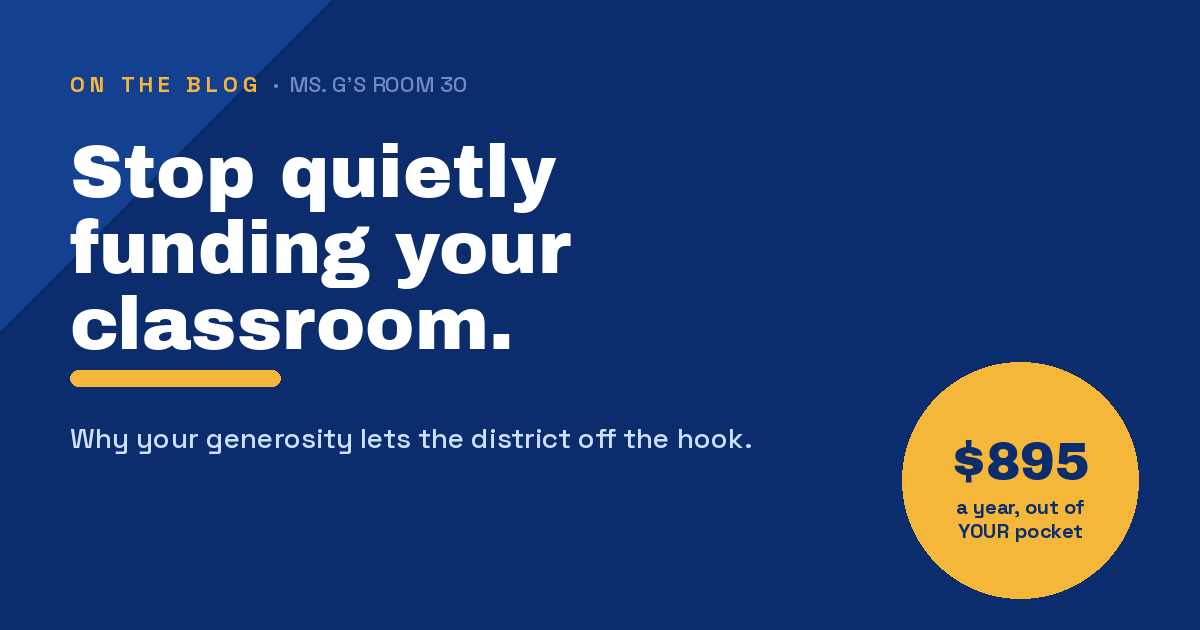
The numbers aren’t a mystery. The 2025 AdoptAClassroom survey found teachers spent around $895 of their own money last year, and 94% of teachers pay out of pocket. The median budget a school actually hands you? About $200 — and nearly everyone says it isn’t close to enough.
Here’s the uncomfortable part. A budget meeting can only respond to needs it can see. When you absorb the gap in silence, the spreadsheet looks fine. The classroom is stocked, the kids have markers, and on paper nothing is wrong. Your generosity didn’t just help your students — it also quietly proved that the current budget “works.”
Teacher move: stop making the gap invisible. Keep a running note of what you buy and why. You don’t have to wave it around — but you should be able to name it, out loud, the next time someone asks how the budget is holding up.
Generosity and martyrdom are not the same thing
One fills your room. The other empties you.
Generosity is giving from a place of plenty — a little extra, freely, because you can. Martyrdom is giving past the point where it costs you: your sleep, your groceries, your own kid’s back-to-school budget. The “whatever it takes” badge quietly asks you to keep choosing the second one and calls it commitment.

You are allowed to love your students and keep your own card in your wallet. Those two things have never been in conflict — we’ve just been told they are.
Teacher move: set a personal out-of-pocket cap for the year before August spending starts. A number you pick on purpose feels completely different from a number you discover, horrified, in June.
You can be generous AND make the need visible
Let the people who want to help, help.
This is where a classroom wishlist quietly changes the math. It doesn’t make you greedy or unprofessional. It takes an invisible, personal expense and turns it into a visible, shared, completely optional one. Most parents genuinely want to pitch in — they just have no idea what you actually need.

How to run it: Build an Amazon classroom wishlist (about 10 minutes), set it to public, ship to your school, and rank your real must-haves at the top. Then drop the link in the one place families actually read — your syllabus and your email signature — on day one of the first week. That’s it.
“But isn’t it kind of tacky to ask?” (tap)
It’s only tacky when it’s a surprise or a guilt trip. A clearly-optional, low-pressure list — “here’s where our classroom runs, zero obligation” — reads as organized and transparent, not needy. You’re not begging. You’re giving people who already want to help an easy way to say yes.
Teacher move: add one optional line to your syllabus that points to the wishlist, marked 100% optional. It legitimizes the ask and plants it on day one — long before anyone’s wondering why you’re out of dry-erase markers in October.
The most radical thing you can do is stop hiding the bill
None of this is about caring less. It’s about refusing to let your care be the thing that hides the problem. When you make the need visible — calmly, professionally, with an easy way for others to help — you stop subsidizing a broken budget out of your own checking account. And you model something your students should see: needs are normal, asking is allowed, and help is something we let people give.
You don’t have to choose between being generous and being broke. You just have to stop doing it in the dark. Want a head start? Grab my free classroom resources, or get the whole kit below.
Stop funding the classroom out of your own pocket.
Get the free Amazon Classroom Wishlist Kit: the teacher Top 5 (with links), a 10-minute setup cheatsheet, and 3 copy-paste syllabus templates that make the ask feel natural.
Your generosity was never the problem. Hiding it was. Make the need visible, keep your card in your wallet, and let your classroom start funding itself.
— Ms. G
👇 Your turn: be honest — do you keep a classroom wishlist, or does quietly covering the gap just feel easier? Tell me in the comments. I read every one.
Leave a Reply