Free through August 10 — build your whole first week in 60 seconds. Join the Club →

Tag: secondary ELA

  • How to Tell if a Student Used AI to Write an Essay (And Why Detectors Won’t Save You)

    How to Tell if a Student Used AI to Write an Essay (And Why Detectors Won’t Save You)

    You read the essay and your stomach drops. The sentences are too smooth. The vocabulary is suddenly a grade level too high. Something is off — and now you’re trying to figure out how to tell if a student used AI to write an essay. Here’s the honest answer, including the part nobody wants to say out loud: you usually can’t prove it, and the tools that promise you can will get you in trouble.

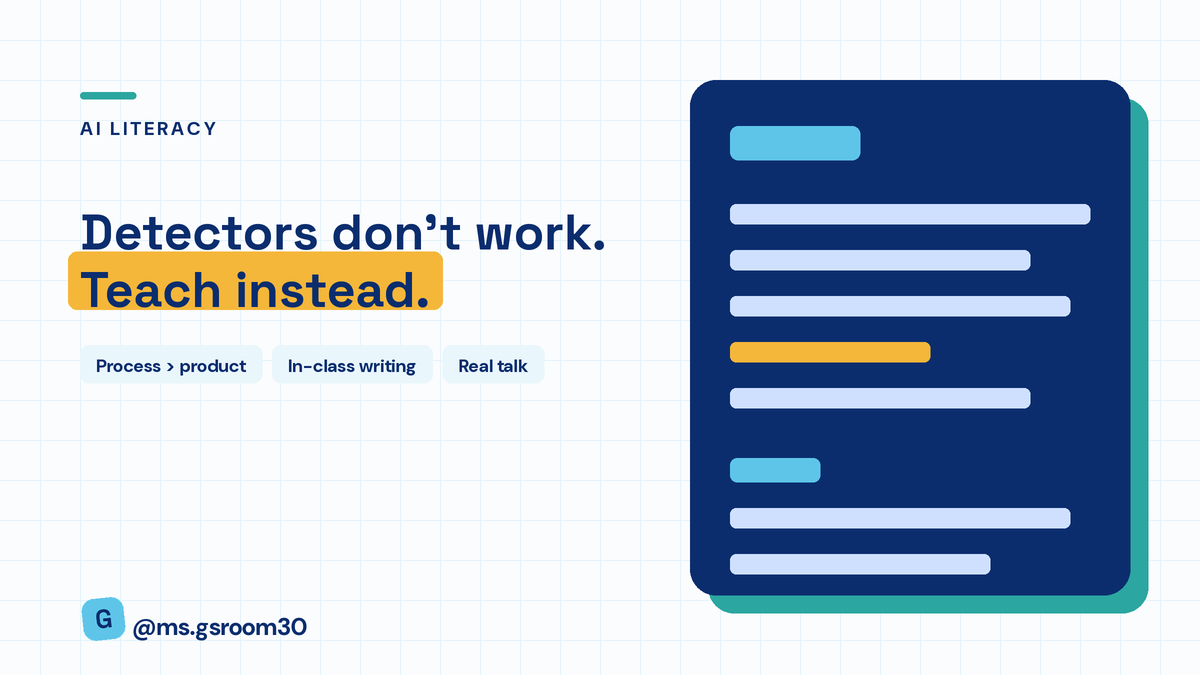
    The hard truth: AI detectors don’t work

    AI detectors feel like the obvious fix. Paste in the essay, get a percentage, done. Except the percentage is mostly noise. These tools regularly flag human writing as AI and pass AI writing as human — and the more polished a real student’s work is, the more likely it gets flagged. A confident number on a screen is not evidence. It’s a guess wearing a lab coat.

    And the failures aren’t random. They land hardest on the students who already get the least benefit of the doubt.

    Why “gotcha” detection backfires

    • Multilingual students get flagged more. Writing in a second language often produces the exact patterns detectors read as “AI.”
    • Neurodivergent and formulaic writers get flagged more. Structured, by-the-rubric writing trips the same wire.
    • One false accusation costs you the room. Accuse a kid who didn’t cheat and you don’t just lose that student — you lose the class’s trust in you as a fair reader.

    You can’t build a writing classroom on suspicion. The second students believe you’re hunting them, they stop taking risks — and risk is where the actual writing growth lives.

    What actually works

    Stop trying to detect the finished product. Start making the process visible — because process is the one thing AI can’t hand a student.

    • Grade the thinking, not just the draft. Require an outline, messy notes, or a brainstorm. The work that has visible fingerprints is the work that’s theirs.
    • Build in low-stakes in-class writing. A few timed, handwritten or in-class paragraphs early on give you a real sense of each student’s voice — your best “detector” is knowing how they actually write.
    • Have the two-minute conversation. “Walk me through this paragraph — why this example?” A student who wrote it can talk about it. A student who didn’t can’t. No accusation required.
    • Design prompts AI is bad at. Tie writing to a specific class discussion, a personal angle, or a text only your room read this week.

    The real fix: teach them to use it on purpose

    Here’s the shift that ends the arms race: the goal was never to catch students using AI. It’s to make sure that when they do — and they will, for the rest of their lives — they’re using it as a thinking partner, not a ghostwriter. A student who’s been taught to draft with AI, then push back on it, revise it, and own the final voice isn’t cheating. They’re doing exactly the skill the world is about to demand.

    That’s a teachable protocol, not a vibe — and it’s one of the three no-prep lessons in my AI literacy bundle for grades 6–12 ELA.

    Related: How to teach AI literacy in the ELA classroom (without banning ChatGPT).

    Stop policing AI. Start teaching it.

    Three no-prep AI literacy lessons for grades 6–12 ELA. Open and teach.

    More real talk over on Instagram.

  • How to Teach AI Literacy in the ELA Classroom (Without Banning ChatGPT)

    How to Teach AI Literacy in the ELA Classroom (Without Banning ChatGPT)

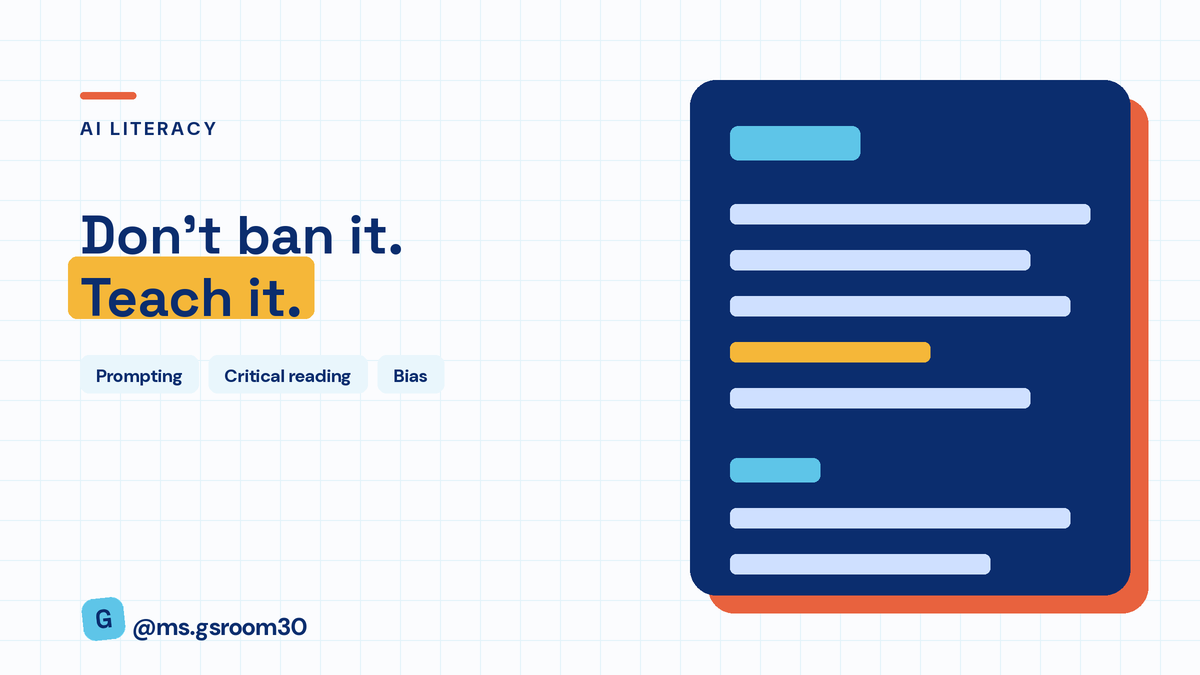
    Here’s the conversation happening in every ELA department right now: half the room wants to ban AI, the other half is quietly terrified it’s already too late. Both are missing the point. Your students are going to use AI for the rest of their lives — the real question isn’t whether they’ll touch it, it’s whether anyone ever taught them to use it like a thinker instead of a shortcut. That’s the whole job. That’s what it means to teach AI literacy in the ELA classroom.

    Banning AI doesn’t work — and it costs you more than you think

    A ban feels like control. It isn’t. It just moves the AI use somewhere you can’t see it — onto phones, into group chats, into the 11 p.m. panic before an essay is due. You don’t stop the behavior; you stop the conversation about it. And the conversation is the only part you actually have power over.

    There’s a bigger cost, too. The students who follow your ban — the rule-followers, the anxious ones, the kids who do everything right — are the ones who graduate having never learned to use the most significant writing tool of their lifetime. The students who ignore the ban learn it on their own, badly, with nobody teaching them when it’s lying to them. A ban punishes exactly the wrong kids.

    What “AI literacy” actually means in an ELA classroom

    AI literacy isn’t a tech unit. You are not suddenly a computer science teacher. In an ELA room it’s the same thing you’ve always taught — critical reading, voice, evidence, revision — pointed at a new kind of text. It comes down to four habits:

    • Prompting as a thinking skill. A vague question gets a vague answer. Teaching students to ask precisely is teaching them to think precisely.
    • Reading AI output critically. AI is confident and frequently wrong. “Find what it got wrong” is the most ELA thing you can possibly assign.
    • Protecting their own voice. The danger isn’t that AI writes for them — it’s that they stop being able to tell their voice from its voice.
    • Spotting bias and gaps. Who does the model leave out? Whose story does it flatten? That’s analysis, not coding.

    Three moves to start teaching AI literacy tomorrow

    You don’t need a new curriculum. You need three small shifts you can drop into a lesson you already teach.

    1. Make AI the bad first draft, not the final one

    Have students prompt an AI for a paragraph on the text you’re reading — then spend the period tearing it apart. Where’s the evidence thin? Where does it sound like nobody? Where is it just wrong? They end up doing more close reading than a worksheet ever pulls out of them.

    2. Teach one good prompting framework

    Most students type three words and accept whatever comes back. Give them a repeatable structure — role, task, context, constraints — and the quality of both the output and their thinking jumps. A framework turns “ask the robot” into a skill they can name and reuse.

    3. Build the conversation into your routines

    Name when AI is fair game and when it isn’t, out loud, for each assignment. “AI to brainstorm, your brain to draft” is a rule students can actually follow — and one that teaches the line between using a tool and outsourcing the thinking.

    The no-prep way to start

    If “build all of this from scratch in August” sounds like one more thing on a list that’s already too long — that’s exactly why I made the done-for-you version. Three no-prep AI literacy lessons for grades 6–12 ELA: a prompting framework, an AI co-author protocol, and a bias audit. Open them and teach.

    Related: How to tell if a student used AI to write an essay (and why detectors won’t save you).

    Teach AI literacy without building it yourself

    More free tools and real talk over on Instagram.