Free through August 10 — build your whole first week in 60 seconds. Join the Club →

Tag: academic integrity

  • How to Tell if a Student Used AI to Write an Essay (And Why Detectors Won’t Save You)

    How to Tell if a Student Used AI to Write an Essay (And Why Detectors Won’t Save You)

    You read the essay and your stomach drops. The sentences are too smooth. The vocabulary is suddenly a grade level too high. Something is off — and now you’re trying to figure out how to tell if a student used AI to write an essay. Here’s the honest answer, including the part nobody wants to say out loud: you usually can’t prove it, and the tools that promise you can will get you in trouble.

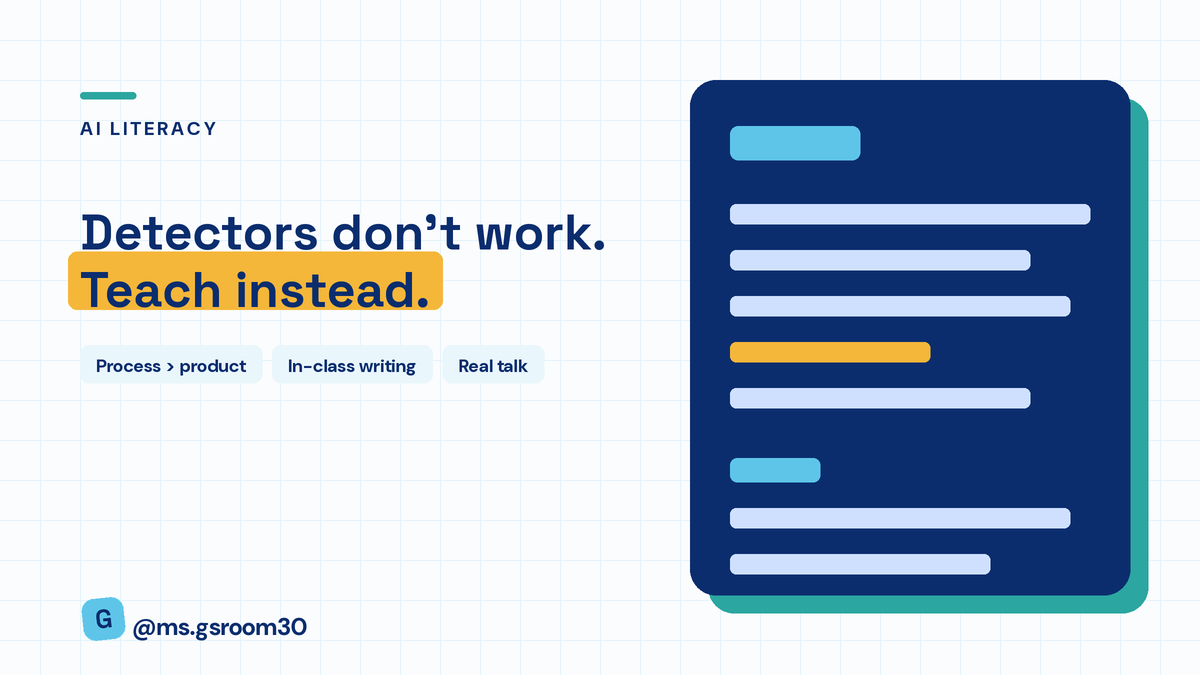
    The hard truth: AI detectors don’t work

    AI detectors feel like the obvious fix. Paste in the essay, get a percentage, done. Except the percentage is mostly noise. These tools regularly flag human writing as AI and pass AI writing as human — and the more polished a real student’s work is, the more likely it gets flagged. A confident number on a screen is not evidence. It’s a guess wearing a lab coat.

    And the failures aren’t random. They land hardest on the students who already get the least benefit of the doubt.

    Why “gotcha” detection backfires

    • Multilingual students get flagged more. Writing in a second language often produces the exact patterns detectors read as “AI.”
    • Neurodivergent and formulaic writers get flagged more. Structured, by-the-rubric writing trips the same wire.
    • One false accusation costs you the room. Accuse a kid who didn’t cheat and you don’t just lose that student — you lose the class’s trust in you as a fair reader.

    You can’t build a writing classroom on suspicion. The second students believe you’re hunting them, they stop taking risks — and risk is where the actual writing growth lives.

    What actually works

    Stop trying to detect the finished product. Start making the process visible — because process is the one thing AI can’t hand a student.

    • Grade the thinking, not just the draft. Require an outline, messy notes, or a brainstorm. The work that has visible fingerprints is the work that’s theirs.
    • Build in low-stakes in-class writing. A few timed, handwritten or in-class paragraphs early on give you a real sense of each student’s voice — your best “detector” is knowing how they actually write.
    • Have the two-minute conversation. “Walk me through this paragraph — why this example?” A student who wrote it can talk about it. A student who didn’t can’t. No accusation required.
    • Design prompts AI is bad at. Tie writing to a specific class discussion, a personal angle, or a text only your room read this week.

    The real fix: teach them to use it on purpose

    Here’s the shift that ends the arms race: the goal was never to catch students using AI. It’s to make sure that when they do — and they will, for the rest of their lives — they’re using it as a thinking partner, not a ghostwriter. A student who’s been taught to draft with AI, then push back on it, revise it, and own the final voice isn’t cheating. They’re doing exactly the skill the world is about to demand.

    That’s a teachable protocol, not a vibe — and it’s one of the three no-prep lessons in my AI literacy bundle for grades 6–12 ELA.

    Related: How to teach AI literacy in the ELA classroom (without banning ChatGPT).

    Stop policing AI. Start teaching it.

    Three no-prep AI literacy lessons for grades 6–12 ELA. Open and teach.

    More real talk over on Instagram.